A declaration ends the hand only when every card is organised according to the rules. Pressing declare with a tidy-looking but invalid group can produce a penalty. The safest habit is to run the same short audit every time: card count, sequence count, pure sequence, group validity and Joker role.
What makes a declaration valid in 13-card Rummy?
A common valid declaration uses all 13 cards exactly once, contains at least two sequences and includes at least one pure sequence without a substituted Joker. Remaining cards must form permitted sequences or sets. Before pressing Declare, count the cards, identify the pure run, verify the second run, check that sets use eligible suits, and state which card every Joker replaces. Frequent failures include mixing suits inside a sequence, counting one card twice, leaving one card ungrouped and treating a Joker-assisted run as pure. The current table’s ace, duplicate-card, Joker and penalty rules remain controlling, so use this checklist as an audit method rather than a universal guarantee.
- One pure sequenceAt least one required run must not use a Joker as a substitute.
- A second sequenceThe hand normally needs another valid sequence, which may be pure or impure.
- All 13 cards accounted forEvery remaining card must belong to a permitted sequence or set under the table rules.
The standard declaration structure
A common 13-card Indian Rummy declaration contains at least two sequences, including at least one pure sequence. The remaining cards must also belong to valid sequences or sets. A pure sequence uses consecutive natural cards from one suit without a Joker replacing a missing card. An impure sequence can use a Joker. A set uses matching ranks from allowed different suits.
The structure matters more than the number of groups. Four groups are common, but longer sequences can produce a different count. Focus on whether all thirteen cards are covered and every required element is present.
Step one: count every card
Before checking sophisticated rules, count the cards in all groups. A normal hand should contain thirteen at declaration. Drag-and-drop interfaces can leave a card between groups or hide it at the edge of the screen. A group can also be counted twice in a mental calculation. Touch each group and total its cards.
If the interface temporarily shows fourteen cards after a draw, discard one before declaring. A declaration made from the wrong card count cannot be corrected by otherwise valid sequences.
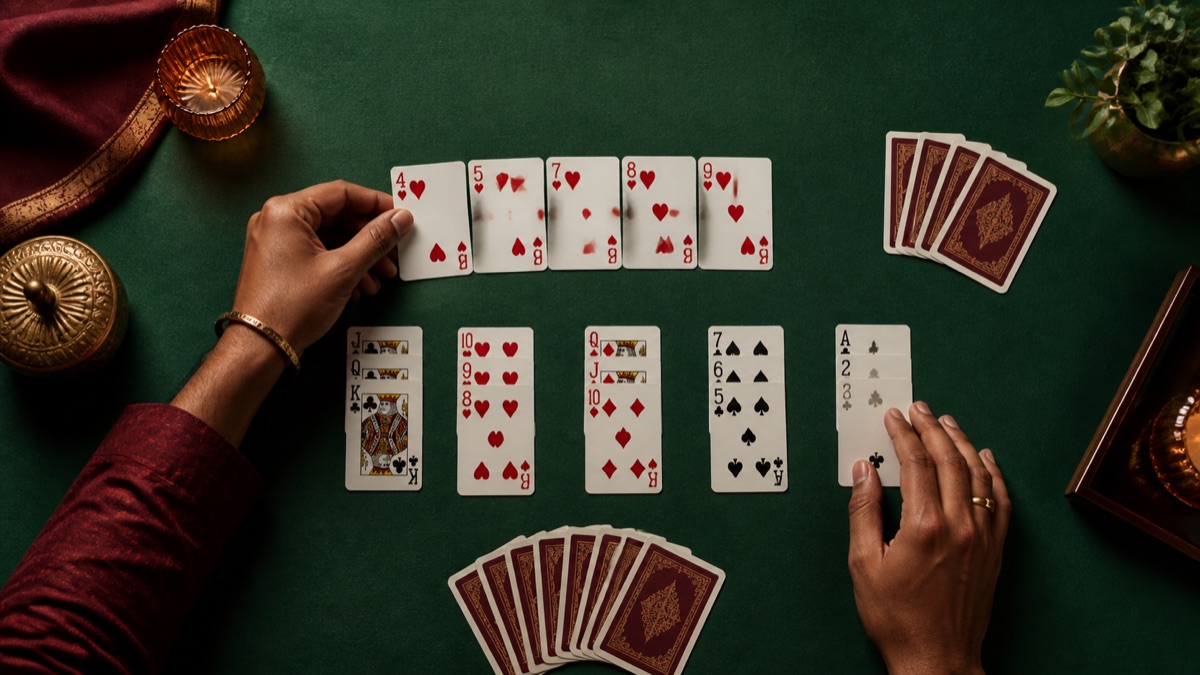
Step two: find the pure sequence
Identify the natural same-suit run and inspect every card. If a printed or wild Joker stands in for a missing rank, the group is impure. Check that the ranks are consecutive and that Ace is placed according to the table’s rules. K-A-2 is generally not a valid wraparound sequence.
Do not assume the longest run is pure. A three-card natural run can satisfy the requirement while a five-card group containing a Joker remains impure. Label the pure group mentally before moving other cards.
Step three: verify the second sequence
The second required sequence may be pure or impure. It still needs consecutive ranks and one suit. A Joker must have an identifiable substituted rank. If natural cards on either side do not create a coherent run, the group is invalid.
A hand with one pure sequence and several sets is not enough when the second sequence is missing. This is one of the most frequent declaration mistakes among new players.
Step four: audit sets and duplicate suits
Check that all natural cards in a set share the same rank. They should represent allowed different suits. Multiple decks can create identical cards, but repeating the same suit within a set is usually invalid under standard rules. A Joker may complete the set where permitted.
A group such as 8♣-8♦-8♠ is a clear set. A group such as 8♣-8♣-8♦ needs careful checking and is commonly invalid because the club suit is duplicated.
Step five: inspect every Joker
For each Joker, say which missing card it represents. This makes hidden gaps visible. If a Joker is sitting in the group but has no necessary role, verify how the platform will classify that group. Never count a Joker-assisted run as the only pure sequence.
After moving a Joker, recheck all affected groups. A flexible card taken from one set may leave that set with too few natural cards.
Practice declarations without a timer
Deal hands face up and write P, I or S beside each group. Ask another player to verify the result. Then deliberately build invalid examples: mixed suits, missing ranks, duplicate suits in sets and a hand with only one sequence. Comparing valid and invalid structures builds faster recognition than memorising a single perfect hand.
When using an App, read its declaration examples because house rules can differ. The final validation belongs to the current table rules, not to a generic article.
Scope of the declaration checklist
RummyGameList prepared this Valid Declaration in 13-Card Rummy: Checklist and Examples guide by separating stable game rules from time-sensitive product and regulatory information. Rule explanations were checked against multiple current guides and arranged as original examples. Product, store and legal claims are treated as dated observations rather than permanent facts. Where a point depends on a particular App or table, the reader is directed back to the current rule screen or official source.
This article is educational information, not legal, financial or security advice and not a promise of winnings. Rummy variations use different house rules. Software can change after publication. Readers should verify developer identity, package ID, permissions, age requirements, regional availability and the current product model before using any App. Corrections can be sent to contact@rummygamelist.com with the source and date.
Audit the declaration from left to right
Read the complete rule or safety explanation once, then test the idea with a non-financial practice example. For a rules topic, lay thirteen cards face up and label each sequence or set before adding a timer. For an App topic, write down the developer, package ID, source URL, version and review date before opening an external file. This turns a broad article into a repeatable check and makes disagreements easier to investigate.
Do not use a single screenshot, rating or search position as final proof. Search results can preserve old pages, store listings can vary by country and promotional websites can repeat the same unsupported statement. Prefer current primary sources, compare dates and state clearly when a fact could not be confirmed. Revisit the guide after a major rule, product or Android change.
Failure cases to catch before pressing Declare
- The hand contains a sequence, but none is pure.
- A Joker group looks consecutive but mixes suits.
- A set repeats the same suit where the table does not allow it.
- One card appears visually grouped twice or one of the 13 cards is left out.
- An ace is placed in a run not accepted by the current rules.
Audit from structure to detail: count 13 cards, find the pure sequence, verify the second sequence, inspect sets and finally name what every Joker represents. This diagnostic focus separates the page from the broader Indian Rummy rules guide.
Frequently asked questions
How many sequences are needed for a valid declaration?
Standard 13-card Indian Rummy normally requires at least two sequences, including at least one pure sequence.
Can the rest of the hand contain only sets?
Yes, after the required two sequences are present, remaining cards may form valid sets or additional sequences.
What happens after an invalid declaration?
Penalties depend on the format and table rules. Check the current scoring screen before playing.
Information only. RummyGameList is not the operator of listed Apps and does not guarantee availability, legality, safety or winnings.