Rummy scoring is easier when card values are separated from declaration structure. Face cards and Aces commonly carry ten points, number cards carry their printed value, and Jokers carry zero. The difficult part is deciding which cards remain unmatched after valid sequences and sets are recognised.
How are card points counted in Indian Rummy?
In a common points system, number cards retain their printed value, while aces and face cards are often counted as 10 points. Cards already arranged in valid sequences or sets may be protected after a valid declaration, while unmatched cards contribute to the losing total. The exact treatment of an invalid declaration, first drop, middle drop and maximum loss depends on the table. Calculate in this order: confirm the pure sequence, validate the second sequence, check the remaining sets or runs, isolate every unmatched card, then apply the current table’s values and caps. Do not transfer a scoring example from Points Rummy directly to Pool or Deals Rummy.
- Common card valuesNumber cards often use face value, while Aces and face cards commonly count ten points.
- Structure before arithmeticValidate the pure sequence and second sequence before counting unmatched cards.
- Format-specific totalsDrop penalties, loss caps and settlement can differ across Points, Pool and Deals Rummy.
Common card values
Number cards from 2 through 10 generally carry their face value. A 4 is four points and a 9 is nine points. Jack, Queen, King and Ace commonly carry ten points each. Printed and wild Jokers generally carry zero points. The scoring screen for the current table remains the final reference because variants can use different caps or special rules.
Card value matters mainly when a card is not protected by a valid group. A King inside a valid sequence does not add ten penalty points. The same King left unmatched can be expensive.
Protected and unmatched cards
After another player makes a valid declaration, the losing hand is evaluated. Cards inside recognised valid groups may be protected according to the format, while unmatched cards are totalled. This is why group validity must be checked before arithmetic begins. A mixed-suit run may look organised but still leave every card exposed to scoring.
Start by marking the pure sequence, then the second sequence, then sets and additional runs. Only after validation should remaining cards be added.
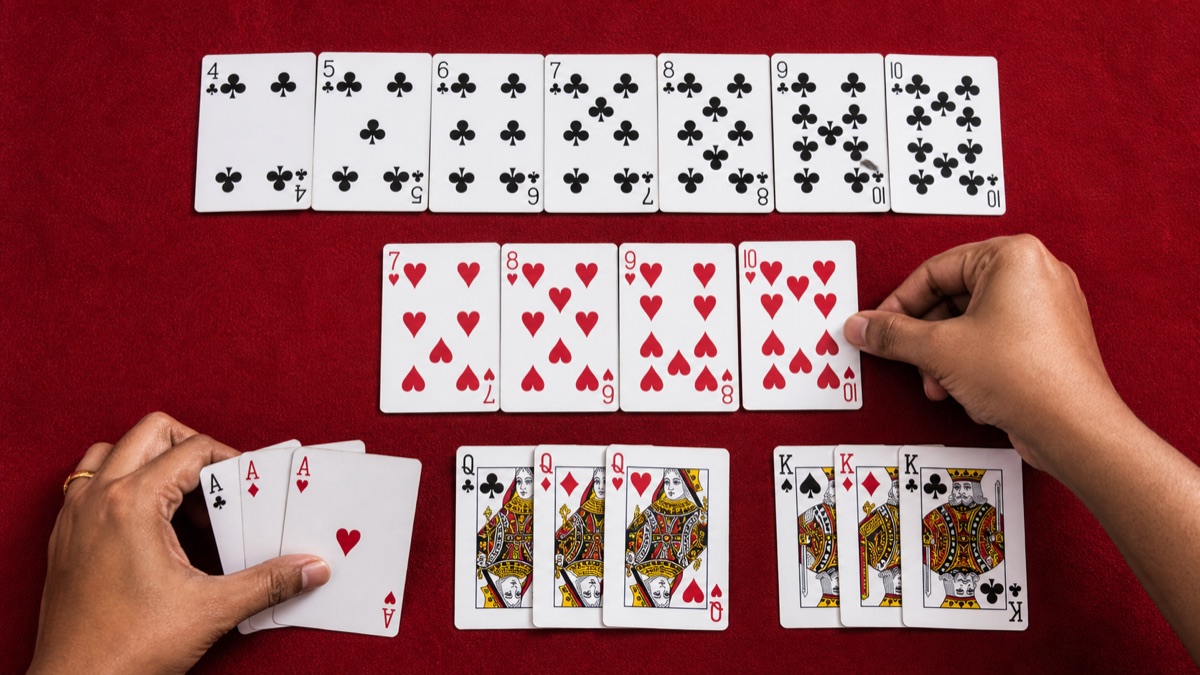
Example with a complete pure sequence
Imagine a hand containing 3♥-4♥-5♥ as a pure sequence and 7♣-8♣-Joker as an impure sequence. It also has Q♠-Q♦-Q♥ as a set, leaving K♣, 9♦, 4♠ and 2♣ unmatched. Using common values, the unmatched total is 10 + 9 + 4 + 2, or 25 points.
This example is illustrative. A platform may apply a maximum penalty or other format-specific rule. Always check the table information before treating an example as a universal payout calculation.
Why the pure sequence changes the calculation
Some Indian Rummy scoring systems provide different treatment when the player has not formed a pure sequence. Without the compulsory structure, cards that might otherwise look grouped may not receive the same protection. This makes the pure sequence important both for declaration and for limiting exposure in an unfinished hand.
Do not assume that merely placing cards together in the interface protects them. The group must satisfy the rules.
First drop, middle drop and full count
Many Points, Pool or Deals formats describe penalties for leaving before or during a hand. A first drop may carry a lower fixed value than a middle drop, while continuing with a weak hand can expose the player to the value of unmatched cards up to a cap. Exact values vary by format and product.
Because these terms can involve financial consequences in some products, use scoring examples for education and practise with non-financial tables. Never interpret a mathematical example as advice to stake money.
A manual scoring routine
Write each valid group on a separate line. Label it pure sequence, impure sequence or set. Cross out protected cards. List every remaining card and convert it to its point value. Add the numbers once, then repeat the calculation from the original hand to catch omissions.
This routine is useful even when an App calculates automatically, because it helps explain why a hand received a particular score and reveals invalid groups.
Reducing high-card exposure in practice
Loose Aces and face cards are worth attention because each commonly adds ten points. That does not mean they should always be discarded immediately; they may be close to a sequence or set. Compare the number of possible connecting cards with the rest of the hand.
Use practice rounds to learn the trade-off. The educational objective is to organise efficiently and understand scoring, not to promise a winning result.
Scope of the scoring examples
RummyGameList prepared this Rummy Scoring Guide: Card Points, Penalties and Examples guide by separating stable game rules from time-sensitive product and regulatory information. Rule explanations were checked against multiple current guides and arranged as original examples. Product, store and legal claims are treated as dated observations rather than permanent facts. Where a point depends on a particular App or table, the reader is directed back to the current rule screen or official source.
This article is educational information, not legal, financial or security advice and not a promise of winnings. Rummy variations use different house rules. Software can change after publication. Readers should verify developer identity, package ID, permissions, age requirements, regional availability and the current product model before using any App. Corrections can be sent to contact@rummygamelist.com with the source and date.
Recalculate a hand before accepting the score
Read the complete rule or safety explanation once, then test the idea with a non-financial practice example. For a rules topic, lay thirteen cards face up and label each sequence or set before adding a timer. For an App topic, write down the developer, package ID, source URL, version and review date before opening an external file. This turns a broad article into a repeatable check and makes disagreements easier to investigate.
Do not use a single screenshot, rating or search position as final proof. Search results can preserve old pages, store listings can vary by country and promotional websites can repeat the same unsupported statement. Prefer current primary sources, compare dates and state clearly when a fact could not be confirmed. Revisit the guide after a major rule, product or Android change.
Worked points example with a protected sequence
Imagine the declared groups include a valid pure sequence ♥4-♥5-♥6, while unmatched cards are ♠K, ♦9 and ♣3. Under a common points model, the unmatched total is 10 + 9 + 3 = 22 points; the protected pure sequence contributes zero. If the required pure sequence were missing, some rules apply a larger full-count treatment instead.
Use the example to understand the calculation order: validate the declaration structure first, separate protected groups, value unmatched cards, then apply drop or cap rules. The current table’s scoring screen remains authoritative because penalties and caps vary.
Frequently asked questions
How many points is an Ace in Indian Rummy?
An Ace commonly carries ten points when unmatched, subject to the specific table rules.
Are cards in a valid sequence counted?
Valid grouped cards may be protected under the applicable scoring rules. Check the format for exact treatment.
Is there a maximum penalty?
Many formats use a cap, but the value can differ. Read the current table’s scoring information.
Information only. RummyGameList is not the operator of listed Apps and does not guarantee availability, legality, safety or winnings.