Pure sequence and impure sequence are among the most searched Indian Rummy terms because the distinction controls whether a 13-card declaration can be valid. Both are same-suit runs, but only one is made entirely from natural consecutive cards. This guide works through the difference slowly and shows how to check a hand before declaring.
What is the difference between a pure and impure sequence?
Both are runs of consecutive ranks from the same suit, but a pure sequence uses no Joker to replace a missing card. An impure sequence uses a printed or wild Joker as a substitute. Thus 4♠-5♠-6♠ is pure, while 4♠-Joker-6♠ can be impure when the Joker represents 5♠. In a common 13-card Indian Rummy format, an impure sequence can help complete the hand but cannot replace the required pure sequence. When checking a group, verify suit, rank order and the role of every Joker. Then audit the complete hand, because a valid sequence does not correct an invalid set or an ungrouped card elsewhere.
- Pure sequenceUses consecutive cards of one suit without a Joker substituting for a missing rank.
- Impure sequenceMay use a Joker to complete an otherwise consecutive same-suit run.
- Declaration checkCommon 13-card rules require at least one pure sequence before the full hand can qualify.
What is a sequence in Rummy?
A sequence is a group of at least three consecutive cards from the same suit. For example, 4♣-5♣-6♣ is a sequence because the ranks are consecutive and every card is a club. A group such as 4♣-5♦-6♣ is not a sequence because the suit changes. A group such as 4♣-6♣-7♣ is incomplete because 5♣ is missing.
Indian Rummy normally requires at least two sequences in a valid declaration. At least one must be pure. The second can be pure or impure, subject to the table’s current rules. Remaining cards may form additional sequences or valid sets.
Pure sequence explained
A pure sequence contains natural cards only. No printed Joker or wild Joker replaces a missing rank. Examples include A♥-2♥-3♥, 7♠-8♠-9♠ and 10♦-J♦-Q♦-K♦, assuming the table follows the common Ace rules. The purity comes from the fact that every card naturally occupies its place in the run.
The pure sequence is compulsory because a hand made only from Joker-assisted groups and sets does not satisfy the standard declaration structure. Players often secure one early, then use flexible cards and Jokers to organise the rest of the hand.
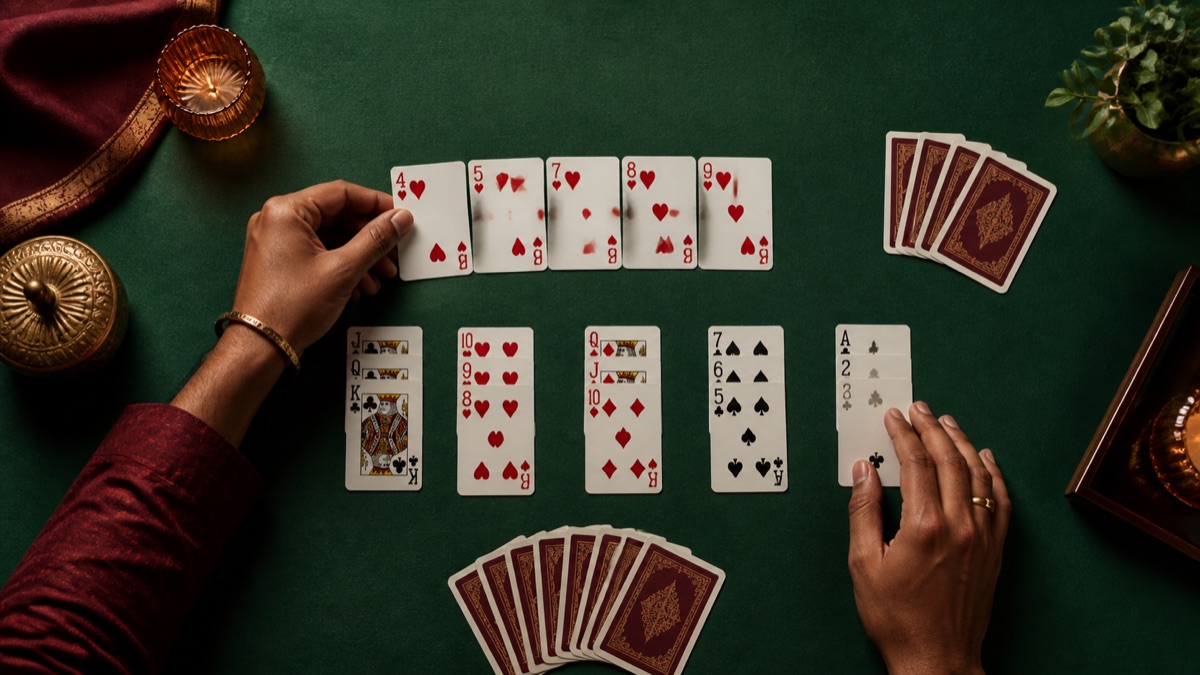
Impure sequence explained
An impure sequence is a same-suit consecutive run completed with a Joker substituting for a missing card. If you hold 5♥ and 7♥, a Joker can represent 6♥ to create an impure sequence. The Joker provides flexibility, but the resulting group cannot count as the compulsory pure sequence.
A printed Joker and a selected wild-rank card can commonly serve this role. Check the App’s rule screen for special treatment of a wild-rank card used in its natural position. Beginner examples should avoid that edge case until the basic distinction is clear.
Valid and invalid comparisons
Compare 8♣-9♣-10♣ with 8♣-Joker-10♣. The first is pure; the second is impure because the Joker represents 9♣. Compare 2♦-3♦-4♦ with 2♦-3♥-4♦. The first is pure; the second is invalid because all cards do not share a suit. Compare Q♠-K♠-A♠ with K♠-A♠-2♠. The first may be allowed with Ace high; the second is normally invalid because Ace does not wrap from King to 2.
Another common error is to place a Joker beside natural cards even though it is not needed. Some interfaces may group the cards, but a declaration checker can still classify the group differently. Build the pure run without substitute cards whenever possible.
How to prioritise groups after the deal
Sort by suit first. Mark any three-card natural runs immediately. Then identify open-ended two-card combinations, such as 6♠-7♠, which can be completed by 5♠ or 8♠. Inside-gap combinations, such as 6♠-8♠, have only one natural completion. This does not mean every open-ended group must be kept; compare its value with the rest of the hand.
After one pure sequence is protected, use Jokers where they remove the most uncertainty. They can complete the second sequence or help organise high-value cards into a set. Do not spend a Joker inside a group that is already naturally complete.
Declaration checklist
Count all thirteen cards. Confirm two or more sequences. Identify at least one pure sequence. Check that each run is consecutive and uses one suit. Check that sets use matching ranks and allowed suits. Confirm that every Joker has a clear role. Finally, make sure no card is accidentally left outside a valid group.
Practise by laying cards face up and labelling each group P for pure, I for impure or S for set. This simple exercise makes declaration errors visible before speed becomes important.
Scope of the sequence comparison
RummyGameList prepared this Pure Sequence vs Impure Sequence in Rummy: Rules and Examples guide by separating stable game rules from time-sensitive product and regulatory information. Rule explanations were checked against multiple current guides and arranged as original examples. Product, store and legal claims are treated as dated observations rather than permanent facts. Where a point depends on a particular App or table, the reader is directed back to the current rule screen or official source.
This article is educational information, not legal, financial or security advice and not a promise of winnings. Rummy variations use different house rules. Software can change after publication. Readers should verify developer identity, package ID, permissions, age requirements, regional availability and the current product model before using any App. Corrections can be sent to contact@rummygamelist.com with the source and date.
Classify a sequence before declaring
Read the complete rule or safety explanation once, then test the idea with a non-financial practice example. For a rules topic, lay thirteen cards face up and label each sequence or set before adding a timer. For an App topic, write down the developer, package ID, source URL, version and review date before opening an external file. This turns a broad article into a repeatable check and makes disagreements easier to investigate.
Do not use a single screenshot, rating or search position as final proof. Search results can preserve old pages, store listings can vary by country and promotional websites can repeat the same unsupported statement. Prefer current primary sources, compare dates and state clearly when a fact could not be confirmed. Revisit the guide after a major rule, product or Android change.
A diagnostic method for borderline groups
First remove every card acting as a substitute. If the remaining group no longer forms a complete consecutive same-suit run, it is impure. For example, ♦6-♦7-Printed Joker is impure because the Joker must represent ♦8 or ♦5. ♦6-♦7-♦8 remains pure even when another card of the wild-Joker rank exists elsewhere; none of these three cards is substituting.
The distinction matters at declaration because many Indian Rummy rules require at least one pure sequence. Check the current table rules for printed Joker, wild rank and ace handling before relying on a borderline example.
Frequently asked questions
Can a Joker be used in a pure sequence?
A Joker cannot replace a missing card in a pure sequence. Special handling of a wild-rank card used naturally depends on the table rules.
Is an impure sequence compulsory?
No. The usual requirement is two sequences with at least one pure. The other sequence may also be pure.
Can a declaration have two pure sequences?
Yes. Two pure sequences can satisfy the sequence requirement, with the remaining cards arranged into valid groups.
Information only. RummyGameList is not the operator of listed Apps and does not guarantee availability, legality, safety or winnings.