What is a pure sequence in Rummy?
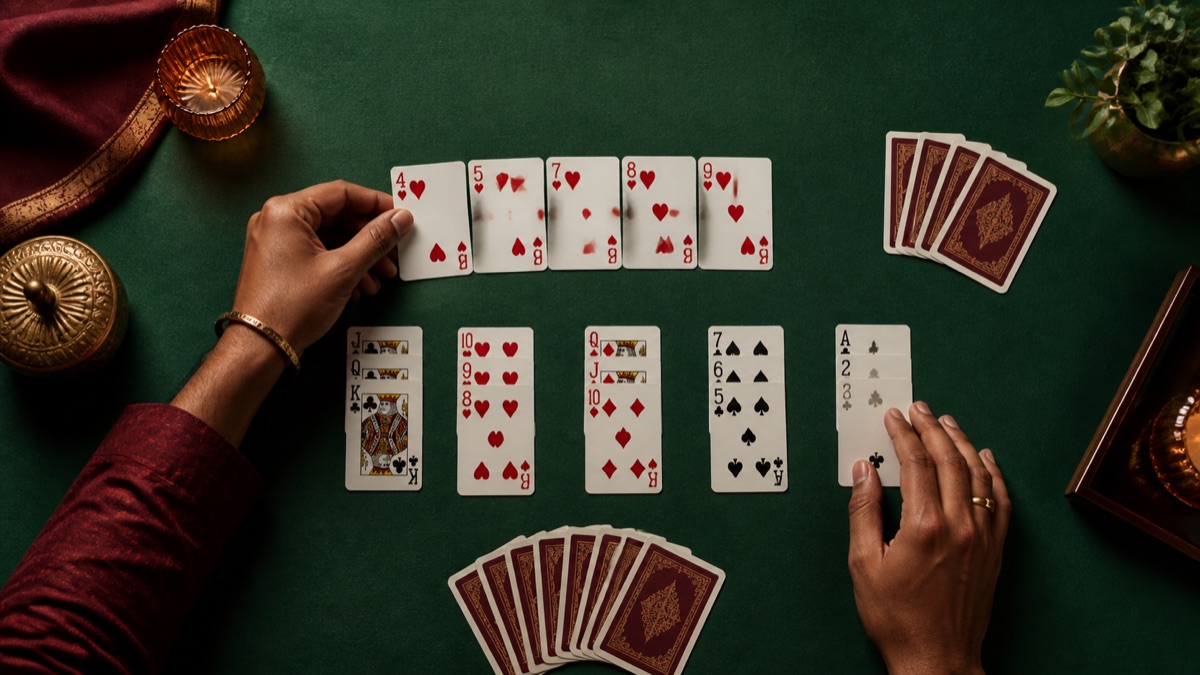
A pure sequence is a group of at least three consecutive cards from the same suit without using a Joker as a substitute for a missing card. For example, 5♥-6♥-7♥ is pure. By contrast, 9♣-Joker-J♣ is impure when the Joker represents 10♣. A wild-ranked card may count naturally when it appears as itself, subject to the table rules. In a common 13-card Indian Rummy declaration, at least one pure sequence and a second sequence are normally required. One correct run is not enough: all 13 cards must be used exactly once in permitted sequences or sets, and the current table’s ace and Joker conditions must still be satisfied.
- Same suitEvery card in the run belongs to one suit.
- Consecutive ranksThe cards follow the table's permitted rank order without a gap.
- No substituted JokerA Joker cannot stand in for a missing card in a pure sequence.
Pure sequence definition
In common 13-card Indian Rummy rules, a pure sequence is a run of three or more consecutive cards from the same suit without using a joker as a substitute. Examples include 4♥-5♥-6♥ and 10♣-J♣-Q♣-K♣.
A set of cards with consecutive ranks but different suits is not a pure sequence. Likewise, three cards of the same rank form a set, not a sequence.
Pure sequence vs impure sequence
An impure sequence also uses consecutive ranks from one suit, but one or more missing cards are replaced by a wildcard or printed joker. For example, 7♠-8♠-Joker-10♠ can be treated as an impure sequence when the joker represents 9♠.
The exact declaration requirement can differ between variants. Many 13-card formats require at least one pure sequence before the rest of the hand can be declared, but you should always read the rules displayed by the table you are using.
How the ace is commonly used
An ace is commonly used low in A-2-3 or high in Q-K-A. It does not normally wrap around, so K-A-2 is not treated as a valid sequence. House rules can vary, which is why examples inside the current game are more reliable than assumptions carried over from another app.
A simple checking method
Before declaring, check four things: all cards have the same suit, the ranks are consecutive, the run contains at least the required number of cards, and no joker is substituting for a missing rank. Then review the rest of the hand against that game's declaration rules.
How to check a pure sequence in three questions
Ask whether every card shares one suit, whether the ranks are consecutive and whether any Joker is substituting for a missing card. If the answers are yes, yes and no, the group can be a pure sequence subject to the table's ace rule. Check the complete hand separately because one valid sequence does not by itself create a valid declaration.
Valid, invalid and ambiguous pure-sequence examples
♥5-♥6-♥7 is pure because the cards are consecutive, share a suit and use no substitution. ♣9-Printed Joker-♣J is not pure because the Joker substitutes for ♣10. ♠Q-♥K-♦A is invalid as a sequence because the suits differ. A-2-3 may be allowed as a low-ace run, while Q-K-A treatment can vary by ruleset.
Use a three-question test: same suit, consecutive ranks, no substituted Joker. Then check the App’s ace rule. This page defines the concept; the separate comparison guide focuses on diagnosing pure versus impure groups.
Frequently asked questions
How many cards are needed for a pure sequence?
Common 13-card Indian Rummy formats use three or more consecutive cards of the same suit, but the table rules shown by the specific game should be treated as final.
Can a joker be used in a pure sequence?
A joker cannot substitute for a missing card in a pure sequence. A printed joker can still act as its natural card when its rank and suit belong in the run.
Is A-2-3 a valid pure sequence?
It is commonly accepted when all three cards have the same suit. Q-K-A is also commonly accepted, while K-A-2 normally is not.
What is the difference between a set and a sequence?
A sequence uses consecutive ranks from one suit. A set groups cards of the same rank, usually from different suits.
Recognising natural runs quickly
A pure sequence contains at least three consecutive natural cards of one suit. Examples include 3♣-4♣-5♣ and 10♦-J♦-Q♦-K♦. The suit must remain the same throughout the group. Cards of matching colour are not enough: hearts and diamonds are different suits, even though both are red. A printed or selected wild Joker cannot stand in for a missing rank inside the pure sequence.
A card that has been selected as the wild rank may sometimes appear as its own natural card, depending on the rules used by the table. This subtle case is a reason to consult the current rule screen rather than relying only on memory. For beginner practice, choose unambiguous examples that contain no Joker-ranked card at all.
Open-ended and inside-gap possibilities
Two consecutive cards such as 6♠-7♠ are open to 5♠ or 8♠. A combination such as 6♠-8♠ has an inside gap and needs exactly 7♠. Open-ended combinations generally have more natural cards that can complete the run, but the decision to keep them also depends on the rest of the hand, discarded cards and the number of turns available.
Do not preserve every near-sequence. Holding several isolated two-card combinations can leave too many unmatched cards. Choose the combinations that connect with the largest part of the hand and release high-value cards that have little support. The pure-sequence requirement is essential, but chasing an unlikely run indefinitely can make the rest of the hand harder to organise.
Common invalid examples
5♥-6♦-7♥ is not a sequence because the suit changes. 4♣-6♣-7♣ is not consecutive because 5♣ is missing. 8♠-9♠-Joker is an impure sequence when the Joker represents 10♠; it cannot serve as the required pure sequence. Q♦-K♦-A♦ may be valid when Ace is high, while K♦-A♦-2♦ is generally invalid because Ace does not wrap between King and 2.
Another mistake occurs when a player rearranges the only pure sequence to complete a set. Before moving a card, confirm that another pure sequence remains. Digital grouping controls make rearrangement easy, but they do not remove the need to check the final structure.
How pure sequences affect the rest of the hand
Once a pure sequence is secure, Jokers can be directed toward difficult high-value combinations or the second required sequence. This reduces uncertainty. However, “secure” should not mean frozen in every situation. Extending a pure sequence can release a nearby card for another group, and splitting a long pure sequence may produce two valid sequences if the final hand still satisfies every rule.
Think of the pure sequence as the structural foundation of the declaration. It does not guarantee a successful hand, but without it the remaining sets and impure sequences cannot create a standard valid declaration. That is why rules guides give it disproportionate attention.
This article is for general information. It is not legal advice, a product endorsement or a promise of winnings. App features and availability can change by version and region.