What are the basic rules of 13-card Indian Rummy?
In a common 13-card Indian Rummy game, each player draws one card and discards one card per turn while arranging the hand into valid sequences and sets. A winning declaration normally uses all 13 cards, contains at least two sequences and includes at least one pure sequence made without a Joker substituting for a missing card. A set groups equal ranks in different suits; a sequence uses consecutive ranks from the same suit. House and App rules can change ace treatment, Joker use, scoring and penalties, so the table displayed by the current game remains controlling. The practical declaration check is: count 13 cards, locate the pure sequence, verify the second sequence, audit sets and identify what every Joker represents.
- 13-card structurePlayers normally draw and discard while arranging all cards into permitted groups.
- Pure sequence requiredA common valid declaration needs at least one sequence without a substituted Joker.
- Table rules still controlAce use, Jokers, scoring and declaration details can differ by format or App.
What is 13-card Indian Rummy?
Indian Rummy is a draw-and-discard matching game. In a common format, each player receives 13 cards and tries to arrange the complete hand into valid sequences and sets before making a declaration.
A turn normally begins by drawing one card from the closed or open pile and ends by discarding one card. The aim is not simply to collect matching ranks; the final hand must satisfy the sequence requirements shown by the table.
Pure sequences, impure sequences and sets
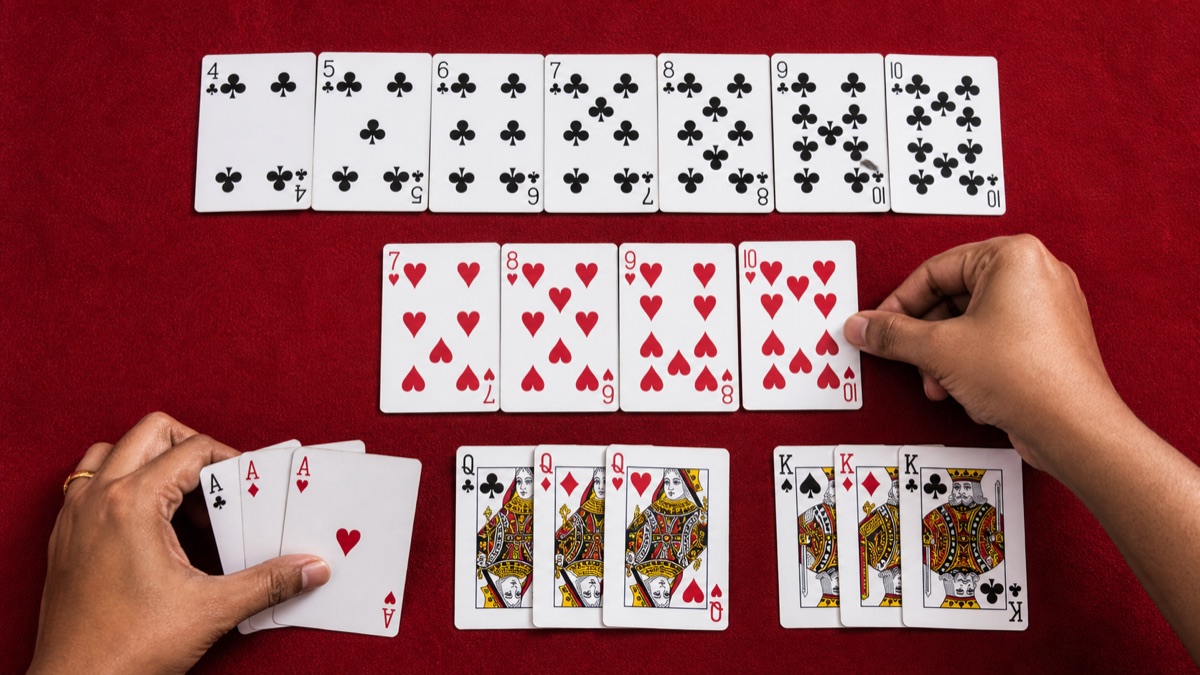
A pure sequence is a run of consecutive cards from the same suit without using a joker as a substitute, such as 4♥-5♥-6♥. An impure sequence follows a valid run but uses a joker for a missing card according to the specific game rules.
A set groups cards of the same rank in permitted different suits, such as 8♣-8♦-8♠. Consecutive cards from different suits do not form a sequence, and matching ranks should not be described as a run.
How jokers and declarations work
A printed joker or selected wildcard can complete an impure sequence or an eligible set. It does not normally replace a missing card inside the pure sequence required for a valid declaration.
Before declaring, check that every card belongs to a permitted group and that the hand includes the required pure sequence. An invalid declaration may carry a penalty, so the rules displayed by the current App or table should be treated as final.
- Build the pure sequence before relying on jokers.
- Keep cards of the same suit together while checking possible runs.
- Review the second sequence and all remaining sets.
- Confirm the table's scoring and declaration conditions.
Points, Pool and Deals Rummy
Points, Pool and Deals Rummy can share the basic 13-card grouping rules while changing how a session is scored or completed. Points Rummy is commonly played as a shorter hand. Pool Rummy continues across hands until a score limit is reached, while Deals Rummy uses a fixed number of deals.
Learning the basic sequence and set rules is useful across these formats, but players should not assume that entry terms, scoring or elimination conditions are identical.
Worked grouping example: audit the hand before declaring
Suppose a 13-card hand is grouped as ♥4-♥5-♥6, ♣9-♣10-Joker, ♠K-♥K-♦K and ♦2-♦3-♦4-♦5. The first and fourth groups are natural runs; the club group is an impure sequence; the kings form a set. The hand contains at least one pure sequence and a second sequence, but the player must still confirm that all 13 cards are used exactly once and that the App’s Joker and ace rules match the table.
The example is a checking method, not a guarantee for every house rule. Count cards, locate a pure sequence, verify the second sequence, audit sets for duplicate suits and then inspect every Joker.
Frequently asked questions
How many cards are used in Indian Rummy?
A common Indian Rummy format deals 13 cards to each player.
Is a pure sequence required?
Many 13-card Indian Rummy formats require at least one pure sequence for a valid declaration. Check the current table rules.
Can a joker be used in a pure sequence?
A joker cannot normally substitute for a missing card in a pure sequence, though a printed joker can act as its natural card when it belongs in the run.
What is the difference between a sequence and a set?
A sequence uses consecutive ranks from the same suit. A set groups cards of the same rank in permitted different suits.
How to organise a 13-card hand
Begin by sorting cards by suit, because sequences must use consecutive cards of the same suit. Look first for natural runs of three or more cards. A hand containing 5♥, 6♥ and 7♥ already has a pure sequence. Protect that group unless drawing another card creates a clearly better arrangement. After identifying one pure sequence, search for a second sequence, which may be pure or may use a Joker according to the rules being followed.
Cards that share a rank but use different suits can form a set. For example, 9♣, 9♦ and 9♠ can be a valid set. Repeating the same suit in a set is generally not valid in standard Indian Rummy. House rules and App implementations can differ, so the current rule screen remains the final reference for a particular table.
Draw, assess and discard
Each turn normally begins by drawing one card from the closed pile or the visible discard pile. The hand temporarily contains fourteen cards. The player then discards one card and returns to thirteen. Use the new card to test more than one arrangement before discarding. A card that seems unconnected may bridge two nearby cards, while a high-value card without a likely sequence can increase the penalty if another player declares.
Observing the discard pile is useful, but it does not reveal an opponent’s entire hand. Avoid making absolute assumptions from a single pickup. The practical goal is to improve your own hand while avoiding obvious gifts, such as discarding the middle card of a sequence that another player appears to be collecting.
What makes a declaration valid
A standard declaration uses all thirteen cards in valid groups and includes at least two sequences. At least one of those sequences must be pure. Remaining cards may form additional sequences or valid sets. An impure sequence can use a printed Joker or a wild Joker as a substitute. A pure sequence cannot use a Joker as a substitute for a missing card.
Before pressing declare, count the cards in every group. Check that sequence cards share a suit and appear in consecutive order. Check that a set uses the same rank across allowed suits. Confirm that the required pure sequence is present. A visually neat hand can still be invalid when one card is duplicated in the wrong suit or a Joker is silently acting inside the only natural run.
Ace, face cards and points
Ace is commonly used low before 2 or high after King, subject to the table’s rules; it does not normally wrap through King-Ace-2. Face cards and Ace usually carry ten penalty points when ungrouped, while number cards carry their printed value. Jokers generally carry zero. These values explain why players often try to place loose high cards into valid groups early.
Learning is easier with open-card examples. Deal thirteen cards face up, practise making one pure sequence first, then complete the rest of the hand without a timer. Once declarations become consistent, add drawing and discarding. Accuracy should come before speed.
This article is for general information. It is not legal advice, a product endorsement or a promise of winnings. App features and availability can change by version and region.