Jokers make Indian Rummy hands more flexible, but they also cause some of the most common declaration mistakes. A Joker can replace a missing card in many impure sequences and sets, yet it cannot replace a card inside the compulsory pure sequence. Understanding the two main Joker types is the first step.
How do Jokers work in Indian Rummy?
A printed Joker or selected wild card can commonly replace a missing card in an impure sequence or an eligible set. It does not normally replace a missing card inside the pure sequence required for a valid 13-card declaration. A wild-ranked card may still appear naturally in a pure run when it represents itself rather than another rank—for example, an 8 of hearts inside 7♥-8♥-9♥ when eights are wild. Before declaring, name the exact card represented by each Joker and confirm that every other card belongs to one permitted group. Because individual tables can limit duplicate cards, ace placement or Joker use, check the current table rules instead of applying one App’s example universally.
- Two Joker rolesPrinted Jokers and the selected wild rank can substitute under common table rules.
- Pure sequence limitA Joker cannot replace a missing card in the required pure sequence.
- Natural use can differA wild-ranked or printed Joker may sometimes appear as its natural card, subject to the table.
Printed Joker and wild Joker
A printed Joker is the dedicated Joker card included in the deck. A wild Joker is usually selected after the deal by revealing a card rank; all cards of that rank can then act as Jokers for that game. If 6 is selected, the sixes of all suits may be used as wild Jokers, subject to the table rules.
Both types can substitute for missing cards in many groups. The interface may display the selected wild rank prominently, so check it before arranging the hand. Do not assume the selected rank is the same from one deal to the next.
Using a Joker in an impure sequence
Suppose you hold 4♦ and 6♦. A Joker can represent 5♦, producing an impure sequence. The suit and order still matter: the natural cards must point to a clear consecutive run. A group of 4♦, Joker and 9♦ does not become valid merely because a Joker is present.
Longer runs can also include a substitution. For example, 8♣-9♣-Joker-J♣ can use the Joker as 10♣. The group remains impure and cannot serve as the required pure sequence.
Using a Joker in a set
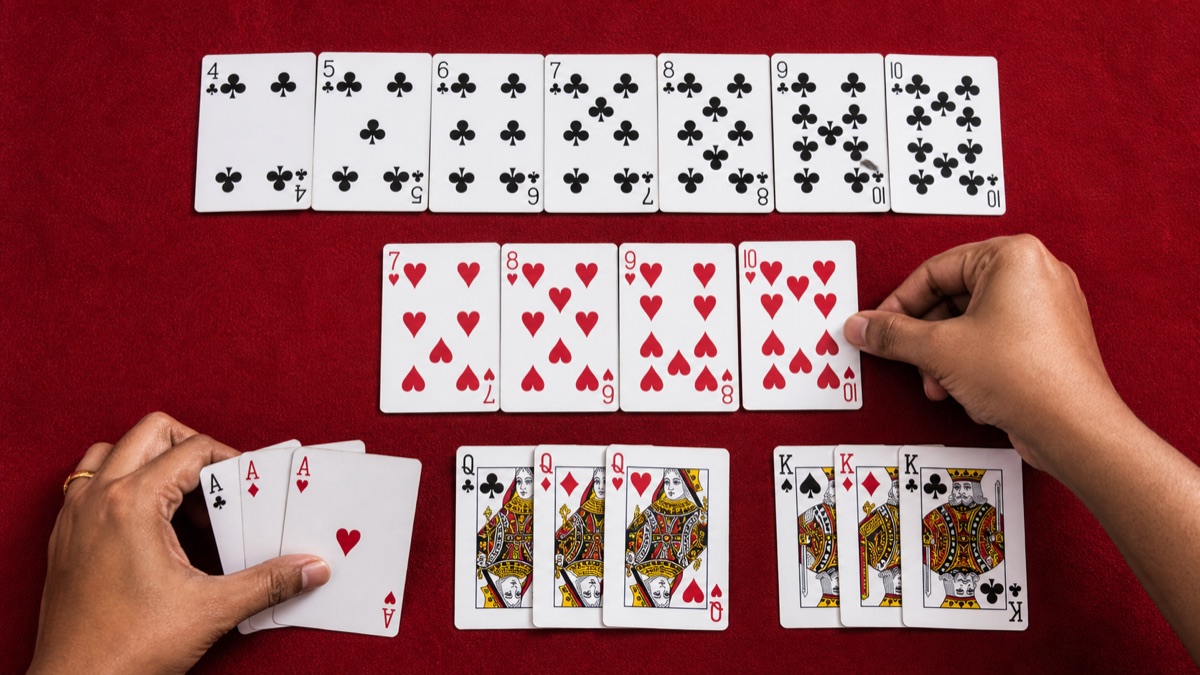
A set contains cards of the same rank from different suits. If you hold Q♣ and Q♥, a Joker may complete a three-card set. A Joker can also replace one member of a larger set where the rules allow. Avoid duplicate natural cards of the same suit inside a set; two identical Q♣ cards from multiple decks do not normally create two distinct suits.
The exact maximum set size can depend on the number of decks and platform rules. Use examples from the current table when learning rather than assuming that every Rummy variation treats duplicate cards identically.
Where a Joker cannot substitute
The most important restriction is the pure sequence. A Joker used as a replacement makes the run impure. Jokers also cannot rescue a group whose natural cards do not point to a valid structure. They do not erase suit requirements for sequences or rank requirements for sets.
Players sometimes keep multiple Jokers ungrouped while searching for the perfect arrangement. Because Jokers generally carry zero penalty points, this may feel safe, but an unorganised hand still cannot be declared. Use them to complete the required structure rather than treating them as automatic winners.
Natural use of a wild-rank card
A subtle question arises when a card’s rank has been selected as wild but the card is used in its natural position. Some common rules allow it to remain natural in a pure sequence when it is not substituting for another card. Other interfaces may display or validate the group differently. Check the rule screen and declaration examples for the exact product.
For clear beginner practice, build the compulsory pure sequence from cards whose rank is not wild. This removes ambiguity and makes the structure easier to audit.
A Joker placement routine
First secure or identify the most promising pure sequence. Second, locate high-value cards that are one substitution away from a second sequence or set. Third, test each Joker in more than one group before fixing it. Fourth, count all thirteen cards and confirm that moving the Joker did not break another group.
A useful drill is to deal an open hand with two Jokers and find three different valid arrangements. The goal is not to claim that one arrangement always wins, but to learn how flexible cards change the structure.
Scope of the Joker examples
RummyGameList prepared this Joker Rules in Indian Rummy: Printed Joker, Wild Joker and Examples guide by separating stable game rules from time-sensitive product and regulatory information. Rule explanations were checked against multiple current guides and arranged as original examples. Product, store and legal claims are treated as dated observations rather than permanent facts. Where a point depends on a particular App or table, the reader is directed back to the current rule screen or official source.
This article is educational information, not legal, financial or security advice and not a promise of winnings. Rummy variations use different house rules. Software can change after publication. Readers should verify developer identity, package ID, permissions, age requirements, regional availability and the current product model before using any App. Corrections can be sent to contact@rummygamelist.com with the source and date.
Audit a Joker group before declaring
Read the complete rule or safety explanation once, then test the idea with a non-financial practice example. For a rules topic, lay thirteen cards face up and label each sequence or set before adding a timer. For an App topic, write down the developer, package ID, source URL, version and review date before opening an external file. This turns a broad article into a repeatable check and makes disagreements easier to investigate.
Do not use a single screenshot, rating or search position as final proof. Search results can preserve old pages, store listings can vary by country and promotional websites can repeat the same unsupported statement. Prefer current primary sources, compare dates and state clearly when a fact could not be confirmed. Revisit the guide after a major rule, product or Android change.
Three Joker placements and how to audit them
In ♣7-Printed Joker-♣9, the Joker can stand for ♣8, producing an impure sequence. In ♥Q-♠Q-Wild Joker, it may complete a three-card set when the table allows that rank and suit combination. In ♦3-♦4-♦5, adding a Joker is unnecessary because the natural run is already pure; using one there can reduce flexibility elsewhere.
During a declaration check, name the exact missing card that each Joker represents. If you cannot name it, the group may be invalid. A Joker cannot rescue a group that breaks suit order, duplicates an impermissible suit in a set or conflicts with the App’s current table rules.
Frequently asked questions
How is the wild Joker selected?
A rank is commonly selected after the deal, and cards of that rank act as wild Jokers for that game.
Can two Jokers be used in one group?
Some rules allow multiple Jokers in an impure group, but the remaining natural cards must still define a valid structure. Check the table rules.
How many points is a Joker worth?
Jokers generally carry zero penalty points, although scoring details should be confirmed for the specific format.
Information only. RummyGameList is not the operator of listed Apps and does not guarantee availability, legality, safety or winnings.